Shower Tray Waste and Trap: Position, Flow Rate and Grate
The waste is the part of a shower tray nobody gives a thought to until water starts pooling around your feet, or that faint drains smell turns up in the mornings. And it turns out this is exactly where you decide whether the shower works well for years. Here’s what really matters: where the waste goes, how much water it has to swallow, what to do about trap height, and how to keep the grate clean.
Where the waste goes: pre-drilled at the factory
Let’s start with what almost nobody tells you before selling. On a mineral-filled resin tray the waste is not drilled wherever you want it: the piece is made with the fall already formed towards one specific point, and that point is fixed for each model. You ask us about this a lot, so here is the straight answer.
On our trays, the position is this:
- Smooth and Slate. The waste sits centred across the width and 37.5 cm from one end, with the fall spread towards it on four planes. The grate is square, 14.3 × 14.3 cm. On square trays it ends up in the middle.
- Elite. The waste is built into the frame at one end, centred across the width and at the bottom of a single fall. The grate is linear, 31 × 6.5 cm.
- Ribera. At the bottom of the fall, in the frame at one end and centred across the width, with a single 2% slope. A cover plate spanning the width of the tray hides it.
This is how it looks on plan. The first is the Quarzo, which the Smooth and the Slate come from, with its three shapes; the second is the Elite:
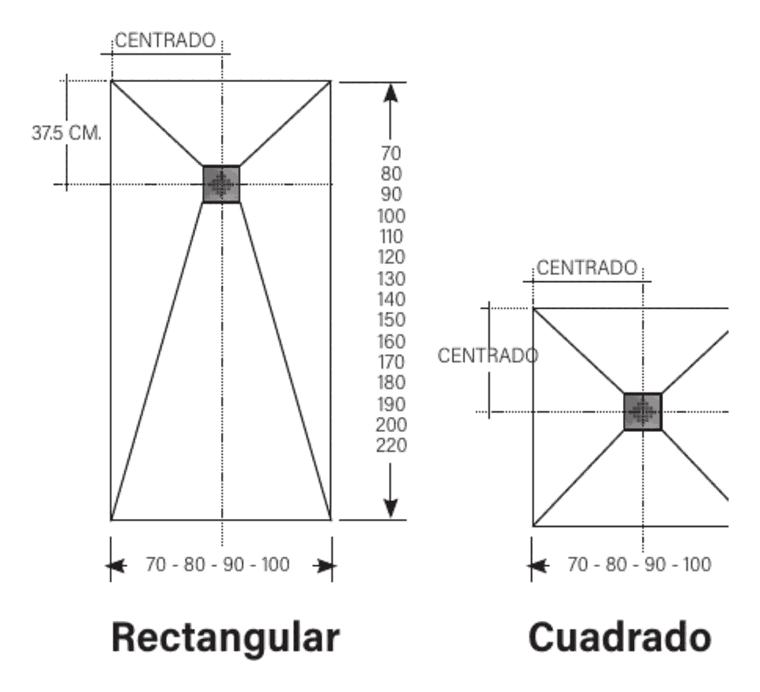
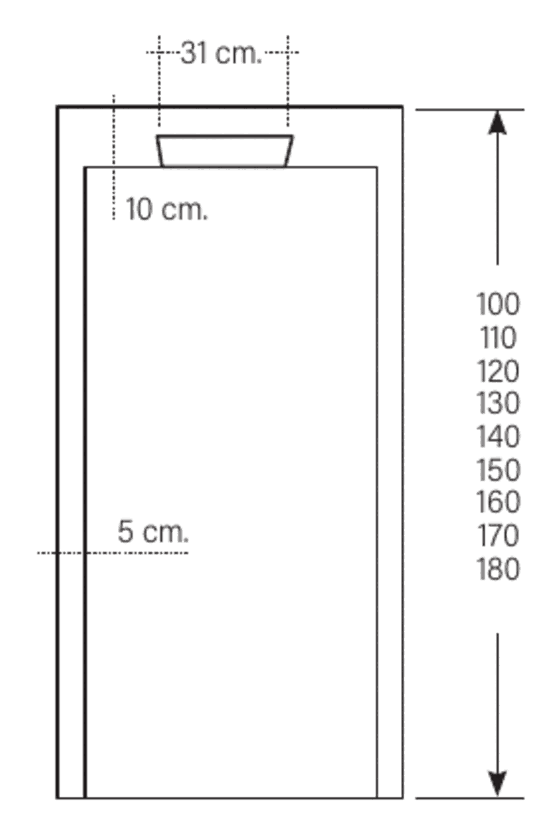
Put the other way round: we cannot put it in a corner, tight against a side, or halfway along a long tray, nor fit two wastes in the same piece. We would rather tell you here than after you have paid.
What is made to your size is everything else: the width, the length, the colour, the finish and the lengthwise cut of up to 10 cm, which always goes at the end away from the waste.
And if my floor outlet doesn’t line up
That is the normal case, and it gets solved during installation, not at the factory. Your plumber links your outlet to the tray’s waste with a run of pipe laid to its own fall: routine work, as long as there is enough height underneath.
So what you want to measure before buying is not so much where your outlet is, but how much clear height you have under the tray. That decides which trap fits, and it is exactly what we look at next.
Flow rate: making sure it swallows everything
This is the point that causes the most trouble and is the least understood. A pretty grate is no use if the trap underneath drains slowly. A rain head or a thermostatic mixer wide open can put out a fair bit of water, and if the waste doesn’t take it away at the same pace, a film of water builds up and rises over your feet.
A good shower tray trap should drain at around 30 to 40 litres a minute. Below that figure you start getting pooling with high-flow showers.
The valve we fit on our trays drains 60 litres a minute with 15 mm of standing water. That leaves plenty of margin even with a big rain head, or with two shower columns running at once on a long tray.
A waste draining 35 l/min versus one at 20 l/min looks the same on fitting day. You notice it every morning, when one clears the tray in seconds and the other leaves a puddle hanging around.
The real flow rate depends on the trap itself, but also on the installation: a waste pipe with too little fall or one bend too many takes a heavy toll. If you’re renovating, it’s worth checking that the floor waste has the right drop before you set the tray down.
Trap height and the problem with flush installs
Here’s the second big headache. The trap takes up height below the tray, and there isn’t always room. In renovations where the tray sits almost level with the finished floor, or on a slab with barely any clearance, a standard trap simply won’t fit.
For those cases there are extra-flat traps, much shallower. They come with a catch: in reducing height, many models also reduce the water seal and the flow rate. So it pays to choose carefully rather than settle for “it fits”. The ideal is an extra-flat trap that still drains with room to spare and keeps a good water seal against odours.
The simple advice: before you buy, measure the actual clearance under the tray. With that figure we can steer you on whether you need a standard or an extra-flat trap, whether in a Smooth finish or the anti-slip relief of the Slate range.
The grate: included, stainless steel and easy to clean
The grate is the visible piece, the one that catches hair and bits before they reach the trap. At Aquatit the grate comes in stainless steel and is included with the tray, just like the trap. No buying it separately, no hunting for odd sizes.
Keeping it clean couldn’t be simpler:
- Lift the grate off (it usually just rests in place or twists a quarter turn).
- Clear hair and built-up soap from the gully basket once a week.
- Rinse the grate and, if you like, wipe it with a mild descaler so the steel keeps its shine.
Five minutes a week heads off 90% of slow blockages.
Bad smells: it all comes down to the water seal
If your shower smells of drains, it’s nearly always down to a water seal that’s too weak or has dried out. The trap works by always holding back a little water that acts as a plug against the gases in the system. If that plug dries up (say, in a second home left shut for weeks) or the trap is too shallow to hold much water, the smells come up.
The fix is a trap with a decent water seal and, for showers used now and then, running the water for a moment every so often to top up the seal. That’s why we keep banging on about not choosing the extra-flat one on height alone.
What to check before you order
The shower tray waste comes down to four things: the position, which on our trays is fixed at the factory; the flow rate, which with our valve is 60 l/min; a trap height that suits the gap under your tray; and a grate you keep clean. The trap and stainless steel grate are included free with every tray we make.
So measure two things before buying: the clear gap under the tray, and the distance from your floor outlet to where the waste will fall. With those two numbers we will tell you straight whether your installation works. Set up your size on made-to-measure and see the price straight away, or tell us about your case via contact.
Ready for your made-to-measure tray?
See trays